Sprungmenü:

English Garden – Munich
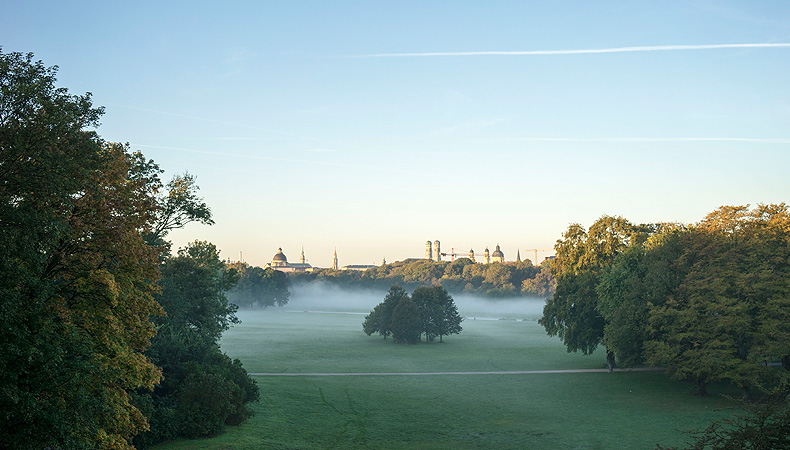
The English Garden is one of the largest inner-city parks in the world. With a length of five-and-a-half kilometres it forms a unique link between the natural landscape along the River Isar and the old city centre of Munich. Friedrich Ludwig von Sckell, the main creator of the English Garden, commented on his work with the words ‘Nature only creates a picture by accident, art does it intentionally’. Although the ‘nature’ here has been designed and planned down to the last detail, the English Garden looks very natural to those who use it, and not at all like a city park.
When Elector Karl Theodor ordered the English Garden to be laid out in 1789, he decreed that it was ‘not to be just for one section of society but for the whole population’. The idea for this decision of such huge benefit to Munich came from the American-born Sir Benjamin Thompson, who later became Count Rumford. In August 1789 the Schwetzingen court gardener Sckell was summoned to Munich to ‘discuss and help create’ a planned public park. The reason that it was laid out so quickly was possibly the social unrest that had led to the storming of the Bastille in Paris.
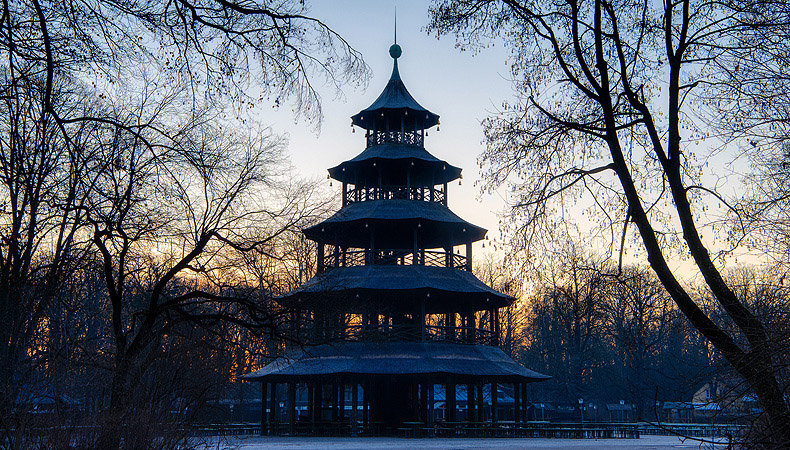
The area designated for the English Garden was a flood plain where willows and prickly sea buckthorn grew. A dam first had to be constructed to prevent further flooding. The area’s transformation into a park under Rumford’s direction was an achievement that cannot be overestimated. In a very short time paths were laid out, trees and bushes planted, bridges constructed and buildings such as the Chinese Tower and Rumford Hall erected (both in 1790).
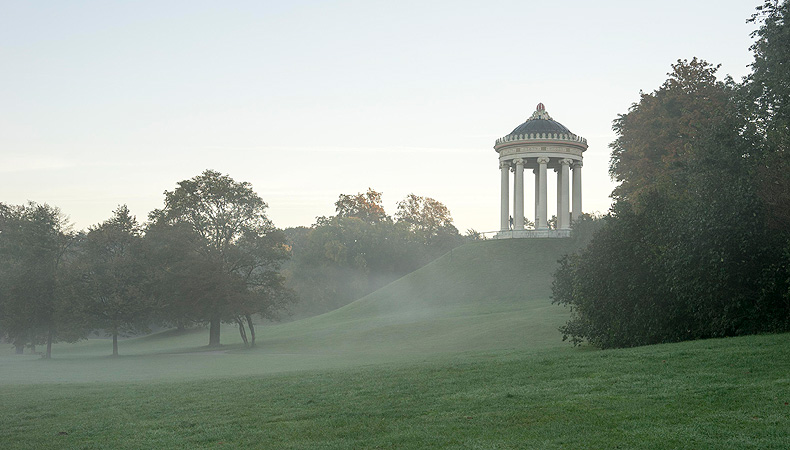
In the year 1800, under Rumford’s successor Baron von Werneck, another 100 hectares of park were added in the north, the so-called ‘Hirschau’. The Kleinhesseloher See (Kleinhesseloher Lake) was created from 1804. During this period Friedrich Ludwig von Sckell had only a limited influence on the park’s development. It was not until he moved in 1804 from Schwetzingen to Munich after his appointment as Bavarian court garden superintendent that the final touches were added to the English Garden to make it one of the most outstanding examples of 19th-century garden design. Many of the paths were altered, plantings were improved and waterways completed. One of the symbols of the English Garden, the Monopteros temple, was only added after Friedrich Ludwig von Sckell’s death. It was designed by the architect Leo von Klenze in 1837 and sited on an artificial hill built and modelled by Carl August Sckell.
Dimensions
-
With an area of 376 hectares respectively 411 hectares (including the Maximilian Park, Court and Finance Gardens), the English Garden is one of the largest inner-city parks in the world (larger than Central Park in New York and Hyde Park in London). It extends from the Court and Finance Gardens at Odeonsplatz into the open countryside far to the north of the city.
-
Of the area of 376 hectares, around 170 ha is woodland, 187 ha meadows and 16 ha water.
-
The network of paths in the English Garden covers a total of 78 km (of which ca 12 km are bridle-paths).
-
The largest area of water in the English Garden is the Kleinhesseloher See with an area of around 8 ha.
-
The streams in the English Garden have a total length of around 15 km.
-
There are over 100 bridges and footbridges in the English Garden.
-
In addition to the 50 – 60 species of bird that breed in the English Garden, there are also hedgehogs, squirrels, wild rabbits, hares, foxes and beaver.
Employees / costs
-
A total of 60 employees are involved in the administration and maintenance of the English Garden.
-
The Free State of Bavaria invests approximately 2.5 million euros annually in the maintenance of the park (2.7 million euros if the upkeep of the buildings is included).
Visitors, services and problems
-
More than 5 million people visit the English Garden every year.
-
There are four restaurants (Aumeister, Chinese Tower, Hirschau and Seehaus) and four kiosks available for the park's visitors.
-
The beer garden at the Chinese Tower is with its 7,000 seats one of the largest beer gardens in Bavaria.
-
Problems have been caused through changes in the behaviour of visitors (use of the meadows, e.g. for nude sunbathing, the wearing of paths across the grass) as well as vandalism and damage.
-
Around 120 tons of rubbish have to be collected and disposed of annually. The main part is caused by weekend visitors who throw their rubbish on the grass.
Address
Englischer Garten
80538 München
Opening hours
Open all year round
Admission charge
Admission free
Accessibility
Mostly flat terrain with paved paths and plenty of seating; the path to the Monopteros is not barrier-free (incline of over 6%).
Barrier-free toilets can be found at the restaurants/ beer gardens "Seehaus", "Hirschau", "Chinesischer Turm" and "Aumeister" as well as at the Tivoli pavilion (kiosk).
Getting here / parking
Munich
www.bahn.com
"Marienplatz"
Bus to "Chinesischer Turm", tram to "Tivolistraße"
Underground parking at "Max-Joseph-Platz" and "Marstallplatz" (here are also bus parking spaces available)
Coach trips through the English Garden
www.kutschen-muenchen.de
Further information
Free wifi available
Event rooms at the English Garden
Service (leaflets, photo/film, links…)
Historic children's merry-go-round
(at the Chinese Tower)
Englischer Garten 4
80538 München
0163 4097316
Opening hours under:
www.historisches-karussell-muenchen.de
Japanisches Teehaus
Königinstraße 4
80539 München
089 224319
Japanese tea ceremony from April to October every second weekend in the month:
Sat/Sun at 2, 3, 4 and 5 pm
www.urasenke-muenchen.de
Restaurant und Biergarten
am Chinesischen Turm
Englischer Garten 3
089 383873-0
www.chinaturm.de
Aumeister Restaurant
und Biergarten
Sondermeierstraße 1
089 325224
www.aumeister.de
Restaurant Seehaus
Kleinhesselohe 3
089 381613-0
www.kuffler.de
Restaurant und Biergarten
Hirschau
Gyßlingstraße 15
089 3221080
www.hirschau-muenchen.de
Minihofbräuhaus
Gyßlingstraße 59
089 36100880
Bio-Imbiss MilchHäusl
Königinstraße 6
089 517297-180
www.milchhaeusl.bio
Administrative office
Verwaltung des Englischen Gartens München
Englischer Garten 2
80538 München
089 3866639-0
Fax 089 3866639-23
gvenglischergarten@ bsv.bayern.de

Facebook Instagram YouTube