
Palaces > Aschaffenburg > Pompeiianum
Pompeiianum – Aschaffenburg
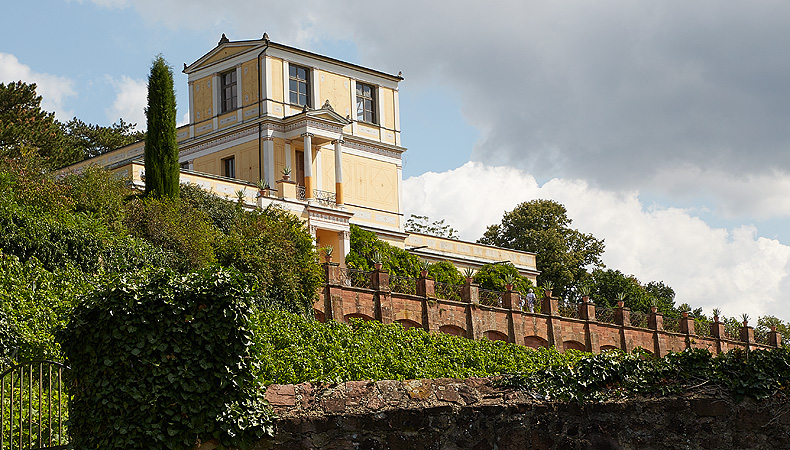
In the palace garden on the high bank of the River Main is the Pompeiianum. Inspired by the excavations in Pompeii, King Ludwig I of Bavaria commissioned the architect Friedrich von Gärtner to build an idealized Roman villa, which was completed from 1840 to 1848 – not for himself but as a place where art lovers could make a study of ancient culture in their own country.
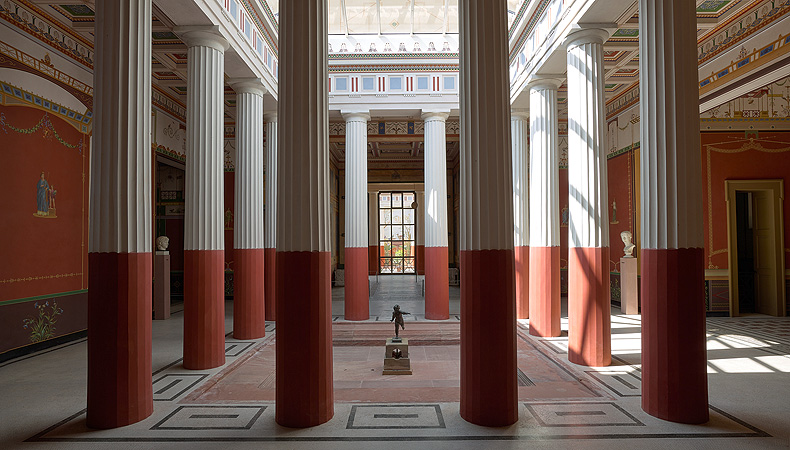
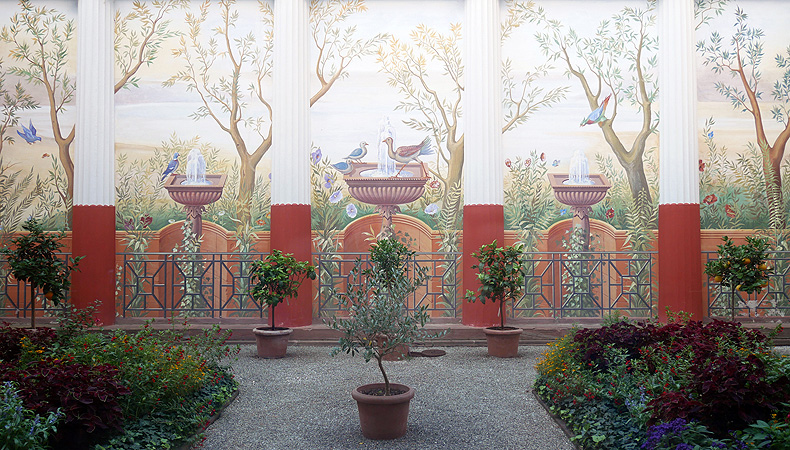
On the ground floor are the reception and guest rooms, the kitchen and the dining room, grouped around two inner courtyards, the Atrium with its water basin and the Viridarium with its garden in the rear section of the house. The splendid decoration of the interior and the mosaic floors were copied or adapted from ancient models.
After severe damage in the Second World War, the Pompeiianum was restored in several stages, beginning in 1960. Since 1994, original Roman works of art from the State Antiquities Collections and the Glyptothek in Munich are now also on display here. Among the most valuable exhibits in addition to the Roman marble sculptures, small bronzes and glasses, are two marble thrones of gods. In addition, there is a different special exhibtion every year on an archaeological topic. The Pompeiianum is surrounded by a small garden which was also only laid out in the mid-19th century. It was to be an ‘ideal Mediterranean landscape’, and still has a flavour of the warmer climes of southern Europe with its fig, araucaria and almond trees, as well as vines, Lombardy poplars and pines.
Short film about the Pompeiianum
Address
Pompejanumstraße 5
63739 Aschaffenburg
06021 218012
www.schloesser-aschaffenburg.de
Opening hours
28-31 March: 10 am-4 pm
(last admission 3.30 pm)
April-3 October: 9 am-6 pm
(last admission 5.30 pm)
4-31 October: 10 am-4 pm
(last admission 3.30 pm)
closed Mondays
(except: Easter Monday, 1 May, Whit Monday, 15 August, 3 October)
closed November-27 March
Admission fees 2026
7 euros regular
6 euros reduced
Combination ticket
(Johannisburg Palace + Pompeiianum)
10 euros regular
8 euros reduced
Children under 18 are admitted free of charge.
Please note that card payments are unfortunately not possible at the ticket offices of Johannisburg Palace and the Pompeiianum.
Accessibility
Getting here / parking
Aschaffenburg
Bus to ‘Stadthalle’
Multi-storey car parks in the city centre
Further information
Branch of the Staatliche Antikensammlungen und Glyptothek München (Bavarian State Collections of Antiquities and Glyptothek in Munich)
Administrative office
Schloss- und Gartenverwaltung Aschaffenburg
Schloßplatz 4
63739 Aschaffenburg
06021 38657-0
Fax 06021 38657-16
sgvaschaffenburg@ bsv.bayern.de
www.schloesser-aschaffenburg.de
