Sprungmenü:

Object description:
New Palace – Bayreuth
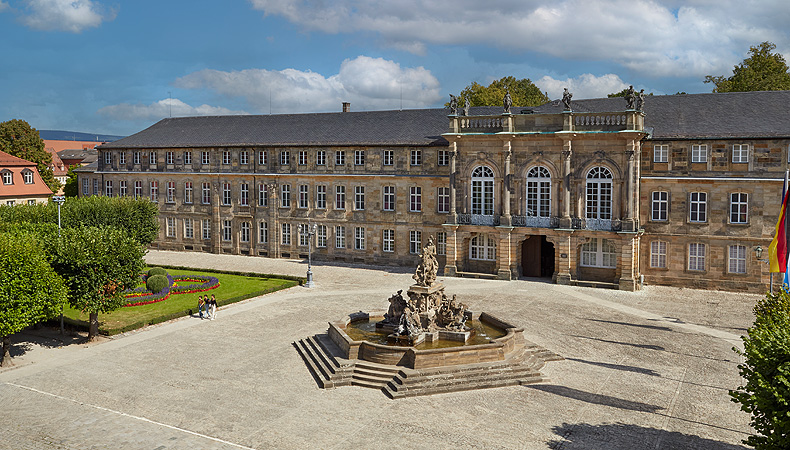
Although the Old Palace erected in the 17th century was an imposing building, it no longer satisfied the requirements of the baroque court. Its destruction in a fire in January 1753 brought forward the decision to build a new palace, which was thus begun in the same year under Margrave Friedrich von Brandenburg-Bayreuth. As with the Old Hermitage Palace, his wife Wilhelmine had a major influence on the design of the rooms.
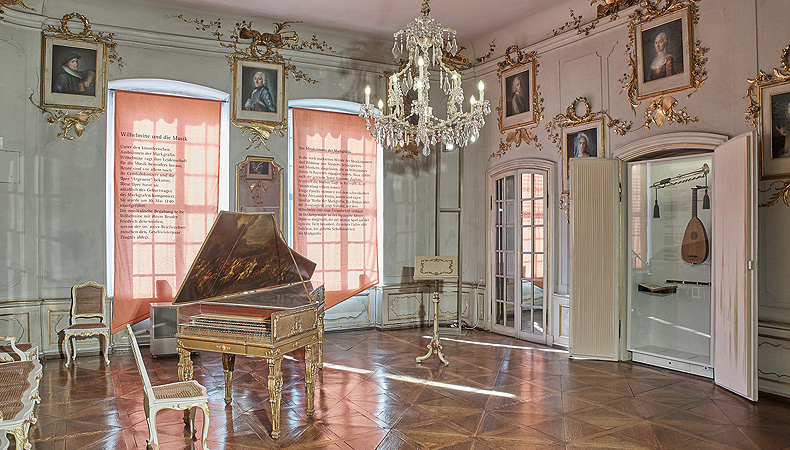
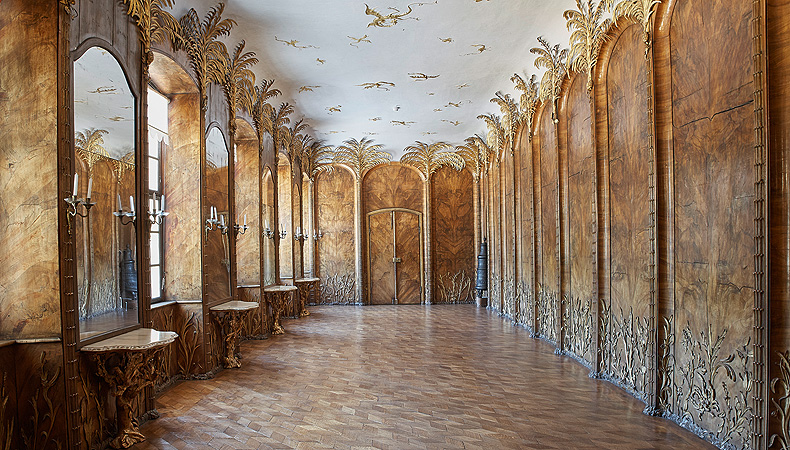
Highlights of the palace are the Cabinet of Fragmented Mirrors, the salon with its gold ceiling, Wilhelmine’s bedroom and the Old Music Room. In the southern wing of the palace is what is probably the finest interior in the Bayreuth rococo style: carved gilt palm trees, their crowns reaching into the sky, are set at intervals along the walnut panelling with its pronounced grain, creating the illusion of a palm grove for the guests who attended banquets here. After the main palace had been completed, in 1759 the margrave began the little, initially free-standing Italian Palace for his second wife, Sophie Karoline von Braunschweig-Wolfenbüttel, which was connected shortly afterwards with the southern wing of the New Palace.
The New Palace includes several museum sections such as the ‘Bayreuth Faience – Rummel Collection’, with items from the Bayreuth Manufactory, the Bavarian State Collection of Paintings, with late Baroque art, and the permanent ‘Dr. Löer Miniatures Collection’ with 18th century erotic works.
At the end of the 18th century the gardens were turned into an ‘English-style’ park with winding paths and natural stands of trees. The dominant features of the geometric garden, the canal and three main avenues, have however remained. In 1990 the parterre in front of the south wing of the New Palace was reconstructed.
Address
Ludwigstraße 21
95444 Bayreuth
0921 75969-21
www.bayreuth-wilhelmine.de
Opening hours
April-September:
9 m-6 pm
October-March: 10 am-4 pm
open daily
Closed on: January 1, Shrove Tuesday, December 24/25/31
Guided tours
The state rooms of the New Palace can be visited without a guided tour.
The Italian Palace can only be visited with a guided tour(every 30 minutes; duration: approx. 45 minutes, in German only, maximum 20 people).
Registration recommended: Telephone +49 921 75969-21
April-September: from 9.15 am (last guided tour 5.15 pm)
October-March: from 10.15 am (last guided tour 3.15 pm)
Admission fees 2024
5.50 euros regular
4.50 euros reduced
Combination ticket
(New Palace + Margravial Opera House)
12 euros regular
10 euros reduced
Combination ticket
"The world of Wilhelmine"
(all Bayreuth objects)
18 euros regular
16 euros reduced
Children under 18 are admitted free of charge.
Accessibility
Getting here / parking
Bayreuth
www.bahn.com
Bus to ‘Sternplatz’
Parking facilities in the centre of Bayreuth can be found at www.bayreuth.de.
Further information
Free wi-fi available
Service (leaflets, photo/film, links…)
Shop
www.kulturgut.de
Archaeological Museum
(Historical Association of Upper Franconia)
0921 65307
Administrative office
Schloss- und Gartenverwaltung
Bayreuth-Eremitage
Ludwigstraße 21
95444 Bayreuth
0921 75969-0
Fax 0921 75969-15
sgvbayreuth@ bsv.bayern.de
www.bayreuth-wilhelmine.de

Facebook Instagram YouTube