
Palaces > Willibaldsburg Castle at Eichstätt
Willibaldsburg Castle – Eichstätt
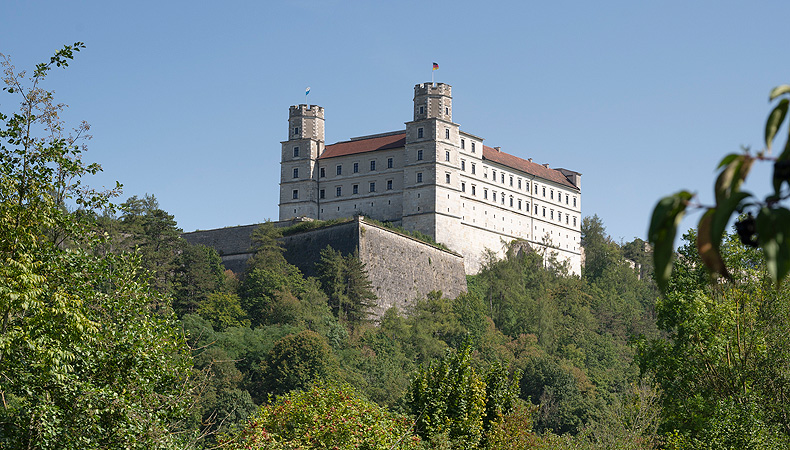
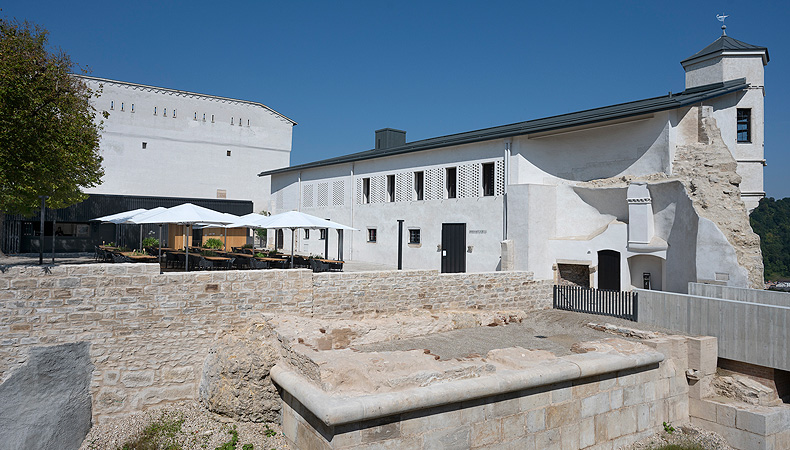
The castle complex on Willibaldsberg was founded in 1355 by the bishops of Eichstätt. It was converted into a representative residence in the reign of Prince-Bishop Johann Conrad von Gemmingen (reigned 1595 –1612) under the direction of the Augsburg architect Elias Holl. The episcopal court moved into the new city residence in the mid-18th century and during the 19th century part of Willibald Castle was levelled. Its appearance today is dominated by the Gemmingen Building. The massive façade with its two towers was originally three storeys high and the towers were crowned with onion domes. However, the monument not only comprises important architecture from the Middle Ages and Early Modern Age. From 1973 to 1976 the interior of the Jura-Museum, which is also a listed building, was redesigned by Karljosef Schattner.
The castle is home to important sights:
-
the Bastion Garden
-
the Jura-Museum and
-
the Museum of Pre- and Early History
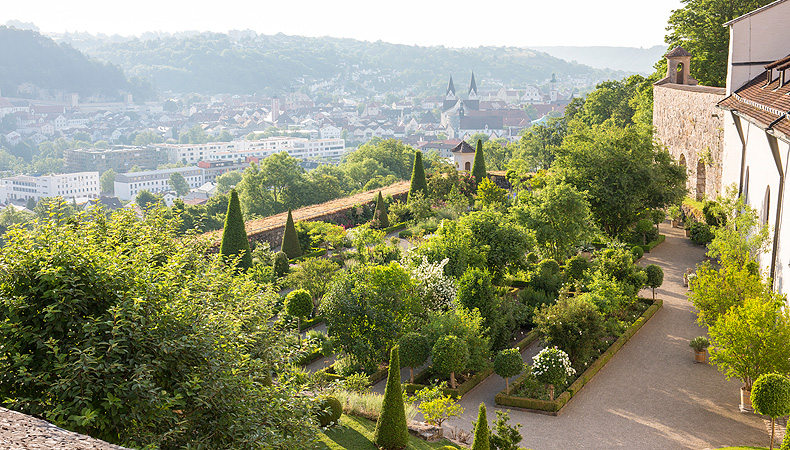
The Bastion Garden, planted on the basis of the collection of copperplate engravings, the ‘Hortus Eystettensis,’ produced in 1613 by the apothecary and botanist Basilius Besler (1561-1629), was opened in 1998. Besler originally laid out the garden at the prince-bishop’s residence from 1592 to illustrate the plant world of the ‘Hortus Eystettensis’, and the new information garden recreates the principles of this once famous botanical garden.
The Jura-Museum takes you on a journey through time to a tropical island, reef and lagoon landscape around 150 million years old, which was populated by fish dinosaurs and crocodiles, coral fish and crabs, insects and pterosaurs. Its most impressive fossils include the only specimen in the world of the Juravenator, a predatory dinosaur, and an Archaeopteryx found in the region. ‘Living fossils’ in aquariums bring to life the colourful diversity of the marine inhabitants that existed during the Jurassic period.
The Museum of Pre- and Early History documents the history of the region from the Stone Age to the Early Middle Ages on the basis of important archaeological findings. Among the outstanding artefacts from these epochs are a mammoth skeleton, the only groma (Roman surveying instrument) north of the Alps and a late Merovingian grave site.
Address
Burgstraße 19
85072 Eichstätt
08421 4730
Opening hours
April-3 October: 9 am-6 pm
4 October-March: 10 am-4 pm
closed Mondays
(except: 6 January, Easter Monday, 1 May, Whit Monday, 15 August, 3 October, 1 November)
Last admission 45 minutes before closing time
Closed on: January 1, Shrove Tuesday, December 24/25/31
Admission fees 2026
6 euros regular
5 euros reduced
Children under 18 are admitted free of charge.
Accessibility
Getting here / parking
Parking is available in the outer bailey and in the car park of the Berufsschule (vocational school) on Burgstraße.
No coach parking spaces
Eichstätt-Stadt
www.bahn.com
Bus (bus stop below the castle)
Further information
Pushchairs can be taken into the exhibition rooms of the Jura-Museum.
Lockers are available in the ticket office building (some with charging facilities).
Service (leaflets, photo/film, links…)
Jura-Museum (Stiftung Katholische Universität Eichstätt-Ingolstadt)
08421 602980-0
www.jura-museum.de
Museum of Pre- and Early History (Historischer Verein Eichstätt e. V.)
0176 62756238
www.histver.de
Burggaststätte „Das Willibald“
08421 607680
www.daswillibald.de
Administrative office
Schloss- und Gartenverwaltung Ansbach
Promenade 27
91522 Ansbach
0981 953839-0
Fax 0981 953839-40
sgvansbach@ bsv.bayern.de
