
Palaces > Herrenchiemsee > New Palace
Herrenchiemsee New Palace
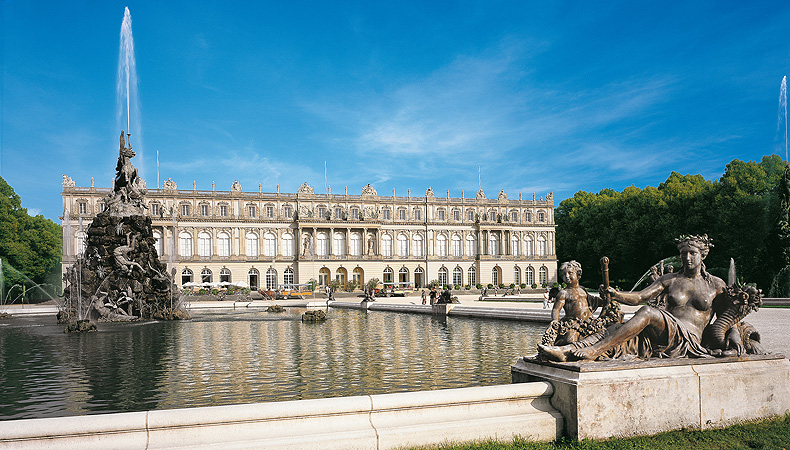
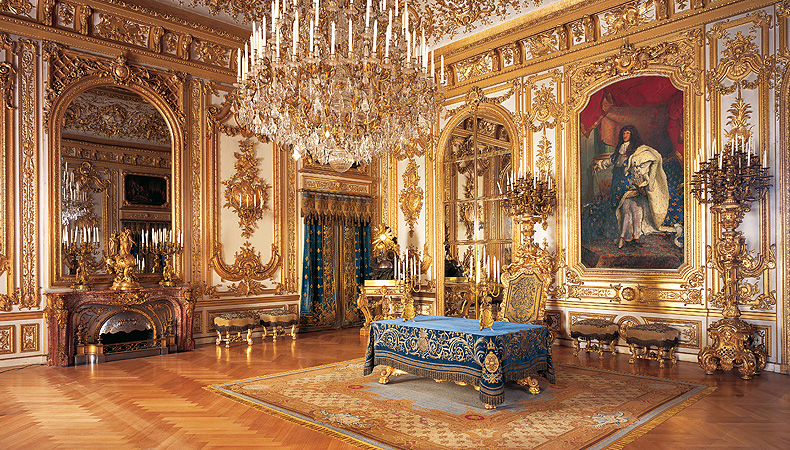
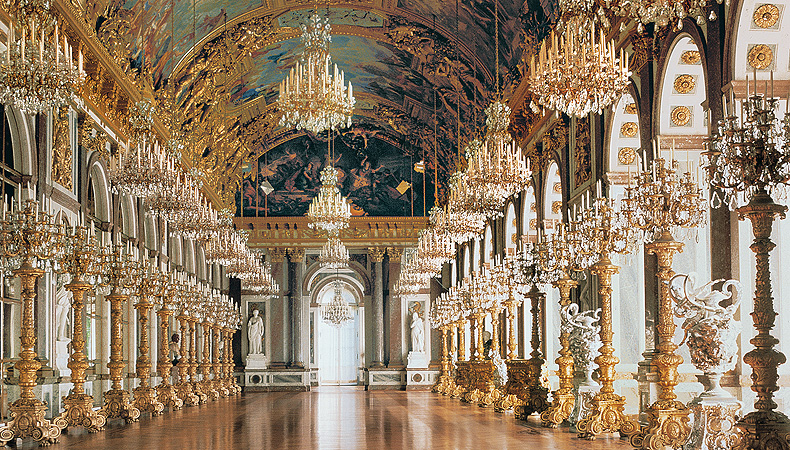
King Ludwig II’s original idea was to have a copy of Versailles Palace built on the Herreninsel as a "Temple of Fame" in honour of the Sun King Louis XIV of France. Started in 1878, it was thus intended purely as a monument to absolute monarchy and had no practical function. The architect Georg Dollmann was obliged to study the original model and even reconstruct rooms which had long ceased to exist in Versailles.
The main rooms are some of the best examples of nineteenth-century interior design in existence, and are much more splendidly furnished than those in Versailles. No other porcelain collection is so comprehensive or of such high quality, and the magnificent textiles are equally unique. One of the artistic ideals of the nineteenth century, the "perfection" of historic styles, was realised in its finest form in this building.
The park modelled on Versailles by Carl von Effner was originally intended to cover a large part of the island. When Ludwig II died in 1886, only the central axis with its splendid fountains was carried out. The palace remained uncompleted.
Since 2025, the palaces of King Ludwig II of Bavaria – Neuschwanstein, Linderhof, Herrenchiemsee and the King's House on Schachen – have been UNESCO World Heritage Sites.
King Ludwig II-Museum
The museum is housed in twelve modernized rooms on the ground floor of the south wing and was opened in 1987. It documents the story of Ludwig II’s life, from his birth to his tragic early death, with painted portraits, busts, historic photographs and original state robes.
The king also has a place in the history of music as the patron of the composer Richard Wagner. Portraits, written documents and theatre/stage designs record this aspect of his life.
The royal residences of Neuschwanstein Castle, Linderhof Palace and Herrenchiemsee Palace as well as Ludwig II’s other building projects are also covered. Highlights of the museum include the magnificent furniture that originally stood in the royal apartment in the Munich Residence (destroyed during the Second World War) and the first state bedroom in Linderhof Palace.
Elaborately handcrafted items, show-pieces that were commissioned by the king, document the European standing of Munich art in the second half of the nineteenth century.
Augustinian Monastery Herrenchiemsee (Old Palace)
Herrenchiemsee Park
Address
83209 Herrenchiemsee
08051 6887-900
www.herrenchiemsee.de
Opening hours
New Palace
April-24 October: 9 am-6 pm
(last guided tour around 5 pm)
25 October-March: 10 am-4.45 pm
(last guided tour around 4 pm)
open daily; guided tour only
King Ludwig II-Museum
April-24 October: 9 am-6 pm
(last admission 5 pm)
25 October-March: 10 am-4.45 pm
(last admission 3.45 pm)
open daily
Closed on: January 1, Shrove Tuesday, December 24/25/31
Guided tours
New Palace
A visit is only possible with a guided tour (c. 40 minutes)
The King Ludwig II-Museum can be visited without a guided tour.
Admission fees 2026
The boat trip is not included.
Combination ticket "Island"
(Herrenchiemsee New Palace with King Ludwig II-Museum + Augustinian Monastery)
11 euros regular
10 euros reduced
Combination ticket "Island"
during the special exhibition »Are we still up to it? – Art and Democracy«
18 May – 18 October 2026
14 euros regular
13 euros reduced
King Ludwig II Museum
6 euros regular
5 euros reduced
Tickets for the museums on Herrenchiemsee are also available online in our ticket shop.
Children under 18 are admitted free of charge.
Accessibility
Water features
May-3 October
Getting here / parking
Prien
www.bahn.com
‘Chiemseebahn’ (in summer) or bus (in winter) to ‘Schiffsanlegestelle Prien/Stock’
Regular boats from Prien/ Stock or Gstadt
www.chiemsee-
schifffahrt.de
Coach trips from the landing stage to the New Palace and back (from mid-April to the end of October)
Further information
Free wi-fi available
Service (leaflets, photo/film, links…)
Shop at boat pier
www.kulturgut.de
Café im Neuen Schloss
08051 968834
schlosscafe-herrenchiemsee.de
Schlosswirtschaft Herrenchiemsee
08051 962767-0
schlosswirtschaft-herrenchiemsee.de
Administrative office
Schloss- und Gartenverwaltung
Herrenchiemsee
83209 Herrenchiemsee
08051 6887-900
Fax 08051 6887-99
sgvherrenchiemsee@ bsv.bayern.de
www.herrenchiemsee.de
